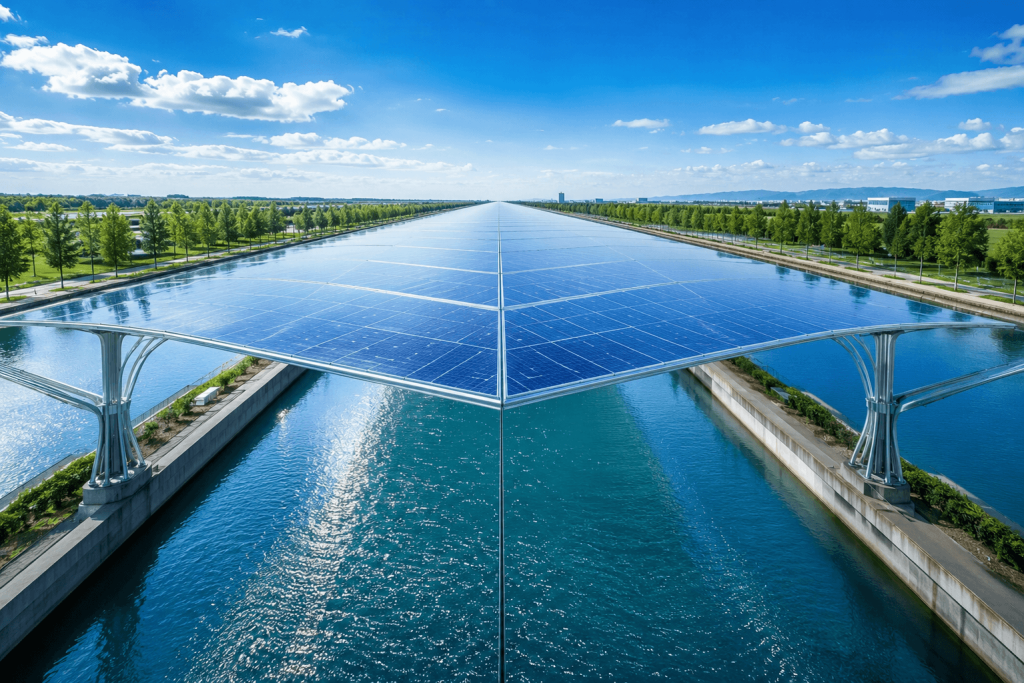
Water scarcity and clean energy generation are two of the most critical challenges facing rapidly growing populations today. In sunny, arid regions, massive open-air canal networks transport fresh water across hundreds of miles to irrigate farmland and supply cities. However, these open canals lose millions of gallons of water every year to direct evaporation from intense sunlight. To solve these two massive problems at once, civil engineers are deploying a brilliant dual-use infrastructure project by covering these open canals with high-efficiency solar panel grids.
The mechanics of this dual-use system create a highly efficient loop of mutual benefits. When solar panels are suspended over a canal, they shield the water from direct sunlight, reducing evaporation by up to ninety percent. At the same time, the flowing water beneath the panels acts as a natural, continuous heat sink. As water flows under the array, it cools the solar cells from underneath, preventing them from overheating. This natural cooling effect increases the electrical output of the solar panels by up to ten percent compared to traditional land-based installations.
This design is already transitioning from academic studies to major real-world infrastructure. In California, a major initiative called Project Nexus is actively installing solar canopies over portions of the state’s vast canal network. Studies show that if all four thousand miles of California’s canals were covered with solar panels, they could prevent sixty-five billion gallons of water loss annually while generating thirteen gigawatts of clean electricity, which is enough to power millions of homes.
“We are bypassing the need for expensive land acquisitions. By utilizing the empty space directly above our existing water infrastructure, we can generate clean energy while protecting our most precious natural resource.”
Beyond the immediate energy and water savings, these solar canopies offer significant structural advantages. The steel and aluminum support frames are relatively simple to install along the canal banks, requiring no expensive land clearing or grading. Furthermore, by blocking sunlight from hitting the water, the solar canopies drastically reduce the growth of aquatic weeds and toxic algae inside the canals. This keeps the water cleaner and significantly lowers municipal maintenance costs associated with dredging and chemical treatments.
As governments globally look to upgrade their utility grids, solar-covered canals will become a key component of modern landscape architecture. The visual aesthetic of these clean, blue water channels flowing beneath shimmering, high-tech glass panels is a perfect representation of the future of sustainable engineering. By transforming passive water channels into active, power-generating grids, we can build a highly resilient resource network that supports both agriculture and clean energy.