As cities expand, urban planners face a massive challenge in managing air quality around busy streets and public squares. Planting trees is a wonderful long-term solution, but urban concrete leaves very little physical space for deep root systems. To solve this immediate air quality crisis, green architects are turning to high-tech, living canopies. These canopy structures are filled with liquid microalgae cultures, creating beautiful, translucent green shelters that purify the air at street level far faster than traditional urban forestry.
The system operates as a functional piece of public infrastructure. Constructed from highly durable, glossy polymer panels, the canopies circulate water filled with active microalgae strains. Large, quiet intake fans built into the support pillars draw in polluted city air and bubble it directly through the liquid bioreactors. The microalgae absorb carbon dioxide, nitrogen oxides, and fine particulate matter, using photosynthesis to convert these harmful pollutants into fresh, pure oxygen that is released back to the pedestrians below.
Because algae grow at incredibly rapid rates, a single urban canopy can filter as much carbon dioxide as several dozen mature trees while occupying only a fraction of the physical ground space. The visual effect is stunning, featuring glowing, green liquid flowing through organic, curved overhead structures. During sunny days, the algae multiply rapidly, turning the canopy a deep, protective green that shades the plaza below while maximizing oxygen production.
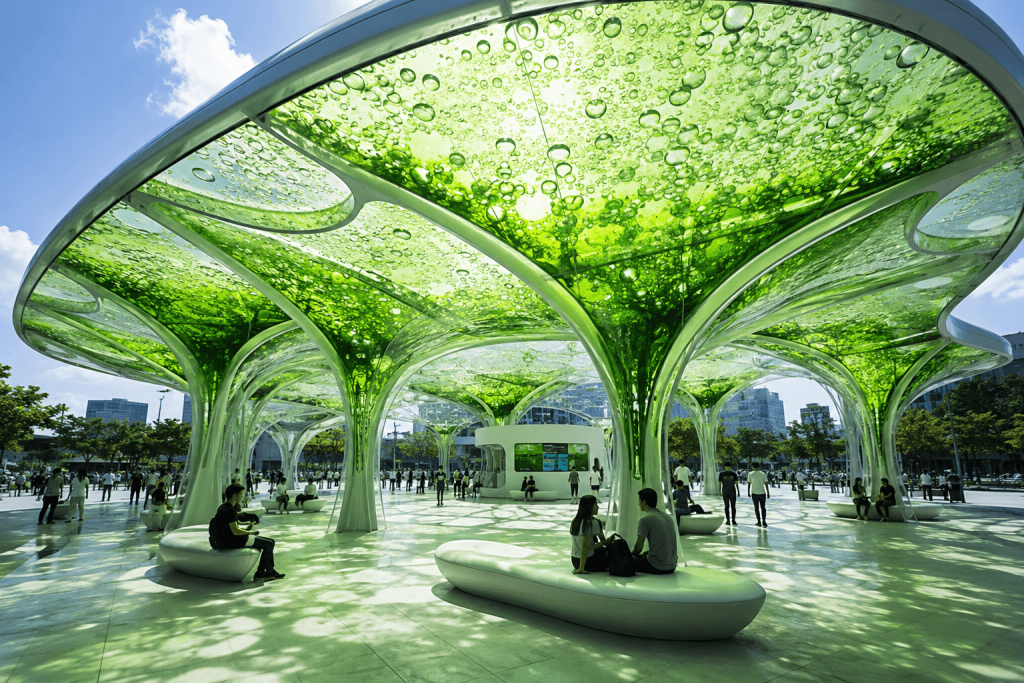
“We are creating responsive urban furniture that actively heals the local environment. These bio-digital canopies demonstrate that our public transit shelters and plazas can function as highly efficient carbon sinks.”
The harvested algae biomass is not wasted. Maintenance teams periodically drain the concentrated algae from the canopy systems and transport it to processing facilities. Here, the organic material is converted into biodegradable plastics, agricultural fertilizers, or clean biofuels. This creates a circular, highly sustainable urban economic loop that actively cleans the air while producing valuable raw materials for the local community.
As municipal governments invest in smarter city designs, these responsive biophilic canopies are being integrated into bus stops, train stations, and public parks. They offer a highly scalable solution to air pollution while bringing a vibrant, organic green aesthetic to gray concrete landscapes. By merging advanced biotechnology with modern public architecture, we are proving that our cities can actively breathe and support human health.