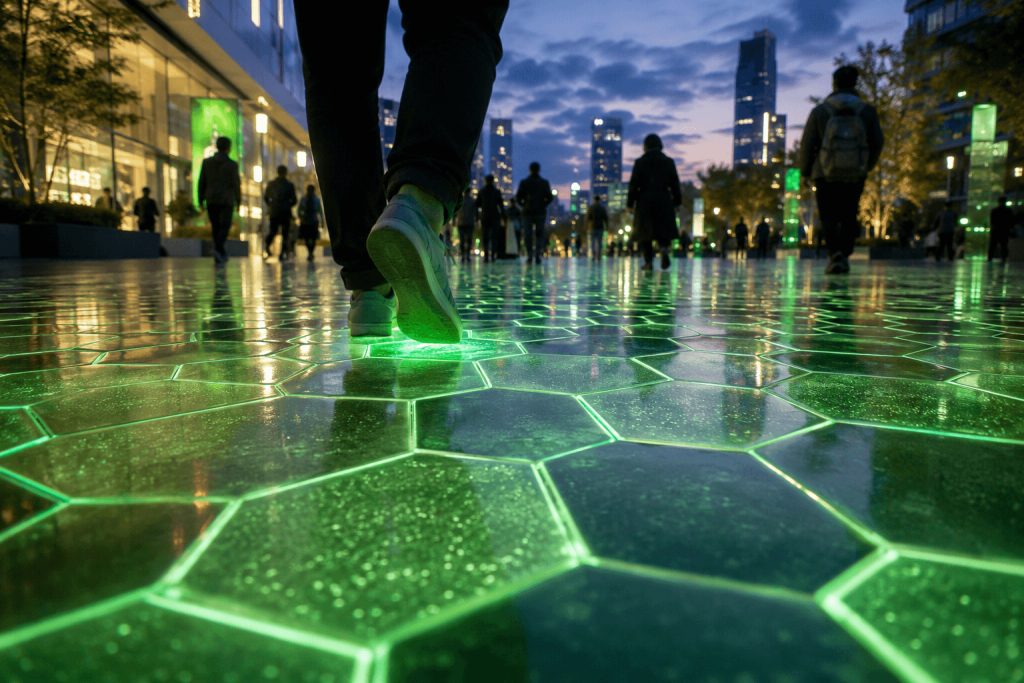
Every single day, millions of people walk through busy city squares, transit hubs, and corporate plazas. The kinetic energy generated by their footsteps is immense, yet it has historically been completely wasted. As cities actively search for localized green energy solutions, a brilliant technology is rising from the ground up. Urban planners are now installing smart pavements that convert physical footsteps into usable electricity. These installations are replacing standard dull concrete with sleek, textured, translucent glass tiles that glow as you walk over them.
This physical energy harvesting relies on a concept called piezoelectricity. When certain materials, such as specific quartz crystals or engineered ceramics, are subjected to mechanical pressure, they generate a small electric current. By placing these high-tech generators directly beneath modular, spring-loaded sidewalk tiles, engineers can capture the downward kinetic force of a pedestrian step. Companies like Pavegen have successfully deployed these systems in high-traffic zones like shopping centers and transport terminals, demonstrating that human movement can power local infrastructures.
The visual design of these pavements perfectly matches their advanced engineering. The top surface of each tile is typically constructed from high-strength, recycled glass or composite plastics. These surfaces are designed with a glossy, slip-resistant texture that allows light to diffuse beautifully. When a pedestrian steps on a tile, the downward pressure triggers an immediate, responsive glow from low-energy LED lights embedded within the glass. This visual feedback makes walking through a smart plaza feel like navigating a responsive, living digital environment.
“We are turning busy public spaces into active, decentralized power plants. By simply going about their daily routines, citizens are actively contributing to the electrical grid of their own cities.”
The generated electricity is stored in localized battery packs hidden beneath the street level or used immediately to power nearby utility systems. A single footstep on a kinetic tile can generate enough energy to power an LED streetlight for several seconds or run a public USB charging station. During peak transit hours, a busy subway entrance equipped with these tiles can generate thousands of watt-hours of continuous power, completely offsetting the carbon footprint of its own lighting systems.
As this technology scales, researchers are looking at integrating solar cells directly beneath the same translucent glass tiles. This dual-source approach allows the sidewalks to harvest solar power during quiet daylight hours and transition to kinetic harvesting during busy, crowded periods. By combining advanced materials science with beautiful responsive design, cities are proving that our urban walkways can be incredibly functional, highly sustainable, and visually stunning.