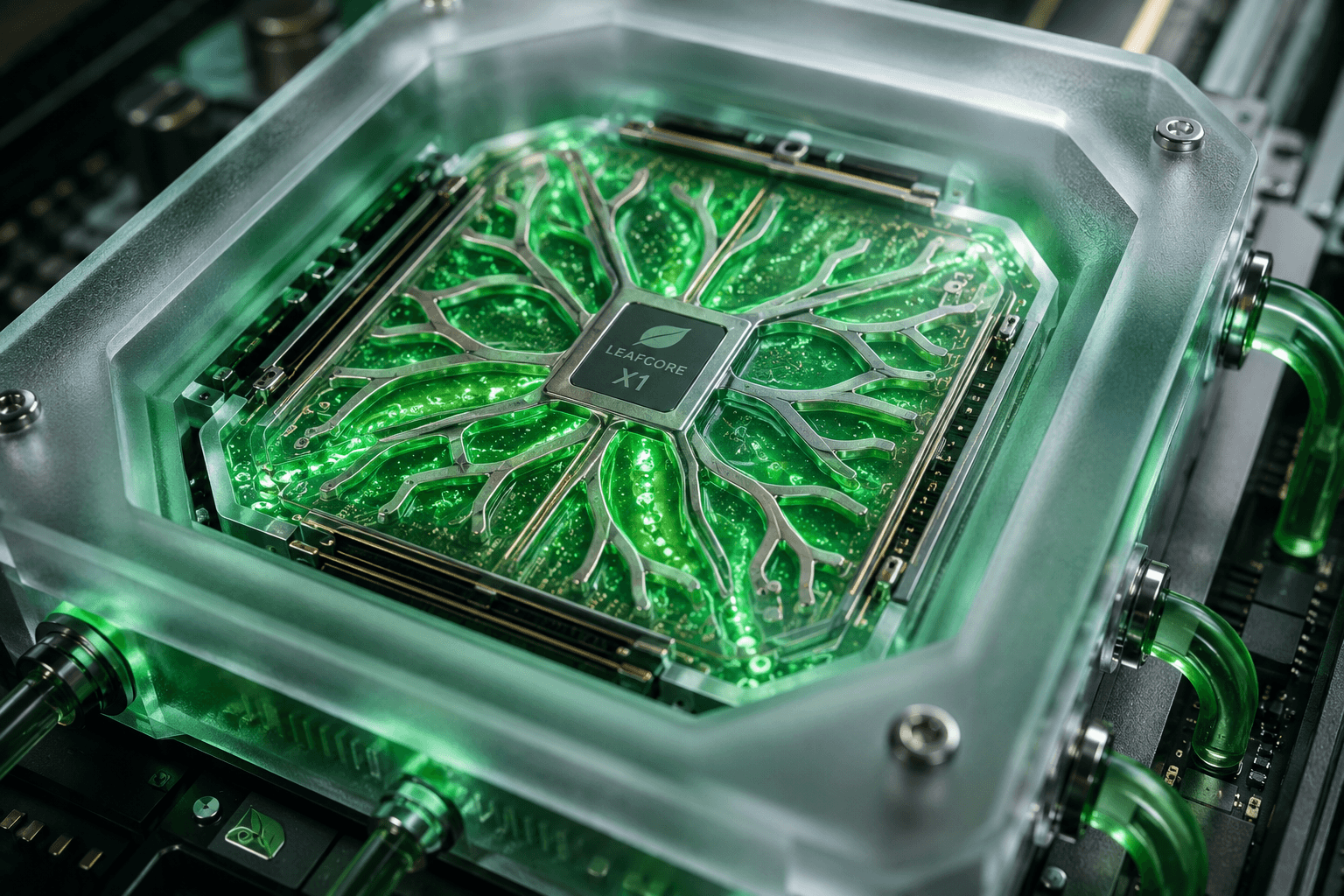
For decades, the tech industry has relied on a singular, brute-force strategy for building faster computers: cramming more microscopic silicon transistors onto physical microchips. But as we push silicon to its absolute physical limits, we face a massive bottleneck in the form of extreme heat. Modern data centers consume a staggering amount of electricity just to run industrial air conditioning units to keep their servers from melting. To solve this, computer engineers are turning away from traditional metal casings and looking closely at plant vascular systems. The future of computing is organic, not mechanical.
Biomimicry is the practice of solving complex human engineering challenges by copying nature’s time-tested designs. In the realm of high-performance hardware, researchers at institutions like ETH Zurich and Oregon State University are now designing microchips with microscopic cooling channels modeled directly after the vein networks found in leaves. These intricate, branching paths transport cooling liquids with virtually zero resistance, allowing heat to dissipate naturally and silently. By mimicking transpiration, which is the biological process of water moving through a plant, these organic-inspired liquid systems can cool a supercomputer up to ten times more efficiently than standard fans.
Beyond physical cooling, the hardware itself is becoming increasingly biological. Neuromorphic computing aims to construct microprocessors that operate like living neural networks. By utilizing bio-compatible materials and structural pathways reminiscent of plant root systems, scientists are creating processors that can handle multiple streams of data simultaneously while using a fraction of the power of a standard chip. This produces a machine that is silent, highly efficient, and housed in a sleek, liquid-filled casing that bridges the gap between hardware and nature.

“Nature solved the problem of fluid transport and thermal regulation millions of years ago. By applying botanical vascular structures to silicon, we can build silent supercomputers that require virtually no external power to run.”
The implications for data storage are equally revolutionary. Researchers at Harvard’s Wyss Institute have successfully demonstrated DNA-based data storage, and biological engineering teams are currently working on storing digital data, such as text, images, and operating systems, directly inside the DNA of living plants. Instead of massive, power-hungry server farms, future archives could exist as lush, indoor botanical gardens. A single seed could potentially hold terabytes of encrypted data, growing into a physical tree that preserves information for generations without requiring a single watt of electricity.
This shift toward bio-digital integration marks the beginning of a new era. We are moving away from noisy, metallic, power-hungry machines and transitioning into a quiet, harmonious relationship with our technology. As these botanical computing systems transition from university laboratories to commercial production, our digital hubs will start looking less like cold industrial warehouses and more like thriving, oxygen-producing ecosystems.